

Guide: Traceability to a Report.
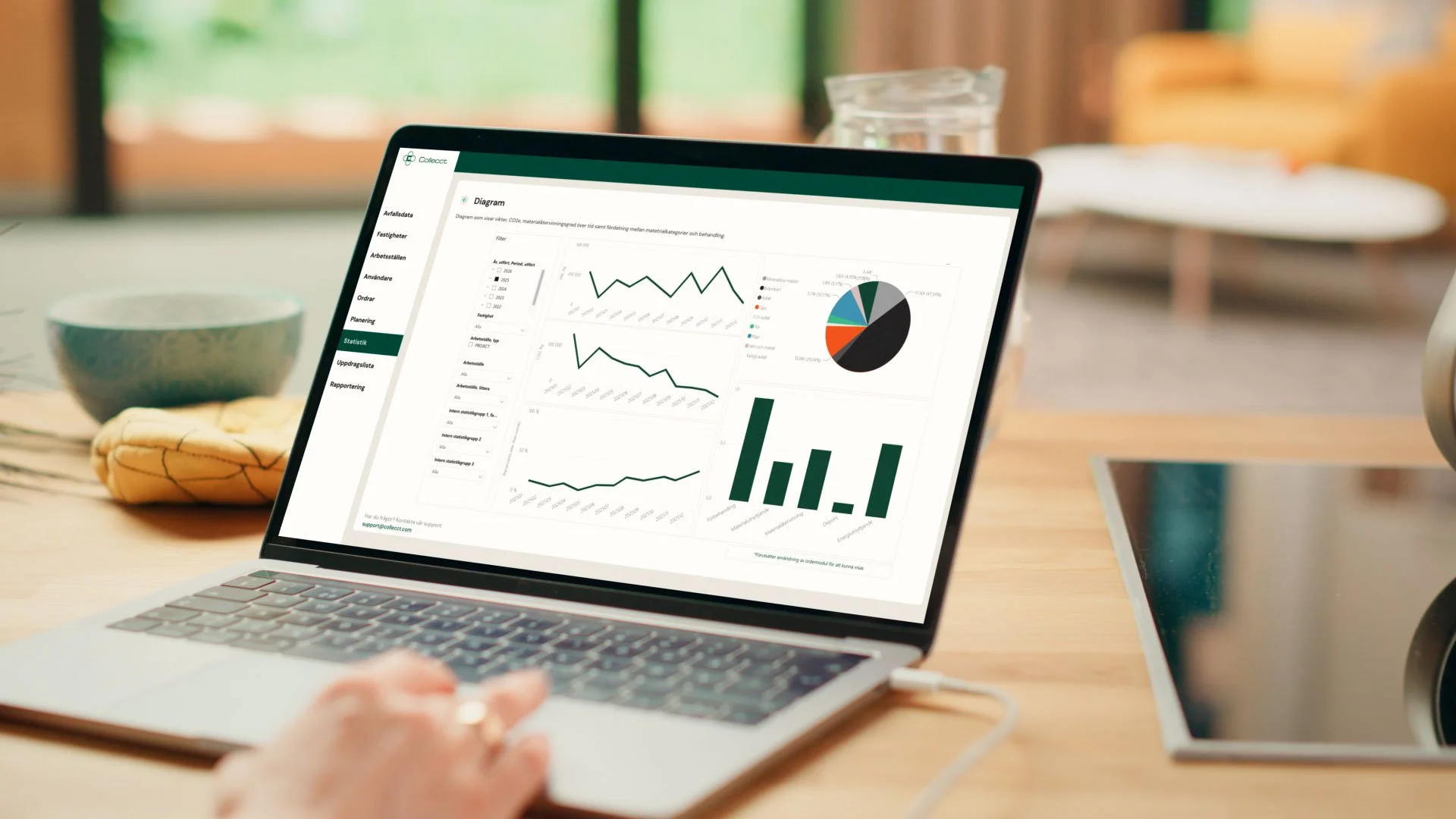
How to Build Traceability from Container to Report
The most forward-thinking companies have already begun to transform their approach to waste materials: from manual piecing together to a structured data chain that provides full traceability and transparency.
This guide shows how you, too, can transition from reactive data collection to a way of working that saves time, reduces uncertainty, and opens up entirely new possibilities for sustainability reporting. At the same time, you’ll receive a practical checklist of what’s required—and how Collecct simplifies the process.
Here's how you can improve traceability. Keep in mind that:
Create a continuous flow of data rather than one-off efforts

Prioritize structure over details—and refine step by step
Use digital platforms instead of manual Excel spreadsheets
Build processes that stand up to scrutiny—every time
That's why some companies are taking action now!
Sustainability requirements are becoming stricter—not only from government agencies and regulations, but also from customers, owners, and boards of directors.
The difference between companies that are one step ahead and those that feel pressured by the reporting cycle often lies in the structure of their data.
Smart organizations have already realized that:
• Fragmented information leads to unreliable conclusions
• Manual data collection does not “scale”
• Credibility requires traceability
• Transparency in material flows creates competitive advantages
This guide explains how you can take the same steps—without making the process unnecessarily complex.
Step 1
Move from data hunting to the data chain
Most businesses spend an unreasonable amount of time searching for supporting documentation: shipping slips in emails, information on invoices, notes on paper. It’s not a traceable process—it’s a guessing game.
Smart companies do this instead:
Checklist: The Data Chain
Gather all your documents in one central hub—Collecct, of course

Ensure that suppliers can submit data digitally
Standardize categories and terms
Automate the validation of incoming data
Establish basic rules for how deviations should be handled
With Collecct, the data chain is integrated: supplier data is “subscribed to,” internal documents are uploaded, and the platform continuously performs quality assurance on everything.
Step 2
Create transparency that strengthens relationships
Companies with a high level of data maturity have realized that traceability isn't just about compliance—it's about trust.
When data is open, shareable, and understandable, waste management companies, municipal agencies, and internal departments can work together more effectively.
Customers who have access to better information become more loyal.
Internal decision-makers have greater confidence in analyses and recommendations.
Checklist: Transparency
Provide relevant stakeholders with access to the same data source
Ensure that the data is understandable and comparable
Use traceability in your interactions with suppliers and customers
Share reporting documents directly from the platform
Transparency is a form of relational capital—and companies that invest in it first are usually the ones that set the tone in their industry.
Step 3
Build a traceable process that stands up to scrutiny
Regardless of which sustainability framework you use, credible reporting requires that you be able to show where the data comes from, when it was updated, and how its quality was ensured.
It requires structure—but it doesn't have to be complicated.
Checklist: Auditability
Version History for All Data Points
Documented checkpoints
Tracking who made which changes
Ability to go back to the source material
System Support for Internal Control and External Auditing
With Collecct, all of these components are included in the purchase. You get a traceable chain from container to report—ready for both internal and external audits.
Step 4
Get the most out of a new way of working
When smart companies shift from a manual to a systematic approach, three things happen:
Reporting becomes faster —data is retrieved in minutes, not weeks.
Quality improves —decisions are based on verified and comparable data.
The organization is becoming more proactive —the focus is shifting from fundraising to improvement.
Checklist: Report-Ready Output
Exports for Sustainability Reporting
Basis for Monitoring Goals and KPIs
Comparisons Between Facilities and Suppliers
Background Information for the Audit
Insights for Reduced Costs and Increased Resource Efficiency
This is where the benefits of a modern data chain become clear: less administrative work, greater precision—and more ability to take action.
What's next?
From Insight to Action
Building an unbroken data chain isn't about doing everything at once—it's about starting in the right place. By establishing the structure early on, you create a process that grows with your needs and can meet the demands of the future.
Would you like to know where your biggest digital gaps are today?
Contact us to schedule a workshop with no strings attached.
In less than 30 minutes, we’ll map out your current material flows, identify your manual bottlenecks, and give you a concrete picture of how you can automate your data collection—from container to report.